.png)
Unrolling a plat map for a pristine 5-acre lot in New Braunfels, Boerne, Bulverde, Spring Branch or Canyon Lake is an unmatched feeling. The sweeping vistas of the Texas Hill Country represent the perfect canvas for your custom estate. However, for many custom home buyers, that excitement is quickly met with a sobering reality: there are no municipal utility tie-ins. Developing raw acreage means becoming your own utility provider. From drilling hundreds of feet into solid limestone for water to navigating strict state environmental regulations for wastewater, managing rural infrastructure requires precision engineering long before foundation forms are set, which is why partnering with an experienced design-build team like KC Custom Homes is essential from day one. This comprehensive guide breaks down the structural, logistical, and financial realities of developing off-grid utilities for your custom home in Comal and Hays Counties.
Unlike building within city limits, sourcing water in the rural Hill Country means looking directly beneath your feet. The vast majority of custom estates in this region rely entirely on private groundwater wells tapped into either the Edwards Aquifer or the Trinity Aquifer system.
Navigating these underground water networks requires strict adherence to local regulations. Depending on exactly where your property line sits, your well will be governed by local entities like the Hays Trinity Groundwater Conservation District or the Trinity Glen Rose GCD, which monitor groundwater drawdowns and establish local spacing rules.
Because the Trinity Aquifer is characterized by low-permeability limestone that recharges slowly, well yields can vary drastically even between neighboring lots. Engineering a reliable water system requires an experienced drilling partner who understands local fault lines and hydrogeology.
One of the most common anxieties for acreage buyers is the unknown cost of drilling. Because groundwater levels are highly variable due to the region's complex faulting and topography, well depth is never uniform.
To give you a reliable baseline for budgeting your project, the table below outlines what we typically see across our primary custom building corridors:
Note: These estimates encompass the complete setup, including the initial borehole drilling, steel or PVC casing, a high-horsepower submersible pump, a heavy-duty storage tank (typically 2,500 to 5,000 gallons to offset low-yield wells), and basic filtration systems.
Pro Tip for Acreage Buyers: Never skimp on storage. If a well test reveals a lower yield (e.g., 3 to 5 gallons per minute), integrating a large atmospheric storage tank ensures your home enjoys consistent, high-pressure water delivery even during peak usage hours or prolonged Central Texas droughts. You can explore real-time regional well data directly via the Texas Water Development Board (TWDB) Groundwater Data Portal.
Once your water source is secured, the next critical infrastructure puzzle is treating wastewater. In the Hill Country, this is rarely as simple as digging a trench and burying a standard tank.
Our region is defined by its geology: thin layers of topsoil sitting directly over solid, fractured limestone. This specific environment presents a major challenge for traditional waste management. Conventional septic systems rely on deep, highly absorbent soil profiles to naturally filter and absorb effluent as it percolates downward. When a site evaluator hits solid rock just 6 inches below the surface, alternative engineering is legally required.
Before any infrastructure work begins, a licensed site evaluator must conduct a comprehensive soil profile analysis and perc test on your lot. This evaluation dictates the precise system design required to secure an On-Site Sewage Facility (OSSF) permit, which is heavily regulated under the Texas Commission on Environmental Quality (TCEQ) OSSF Program guidelines.
Because septic design dictates exactly where your home can be situated, this step must be tightly synchronized with your initial clearing and excavation plans. For a deeper look at how raw terrain shapes your initial development choices, see our companion guide on The Reality of Texas Hill Country Site Prep: Costs, Limestone, & Clearing.
For rural properties across Comal and Hays counties, the choice between septic types usually comes down to what the geology allows.
Because aerobic systems treat effluent to a remarkably high quality before it ever touches the ground, ATUs are the golden standard and the standard legal mandate for over 85% of Hill Country acreage builds.
If your property requires an aerobic system, Texas state law under Title 30, Chapter 285 of the Texas Administrative Code mandates that you maintain an active, ongoing maintenance contract with a licensed provider. This legal framework requires three formal system inspections per year to verify that the air compressors, alarms, and chlorine residuals are functioning perfectly. Expect to budget roughly $250 to $500 annually for this compliance contract, alongside a minor bump in your monthly electric bill to keep the aeration pumps humming.
Bringing electricity and high-speed communications to a home that sits 500 feet back from the main county road involves careful coordination.
When mapping out your infrastructure layout, we work hand-in-hand with regional cooperatives like the Pedernales Electric Cooperative (PEC) or New Braunfels Utilities (NBU) to plot line extensions. You will need to make a critical strategic choice:
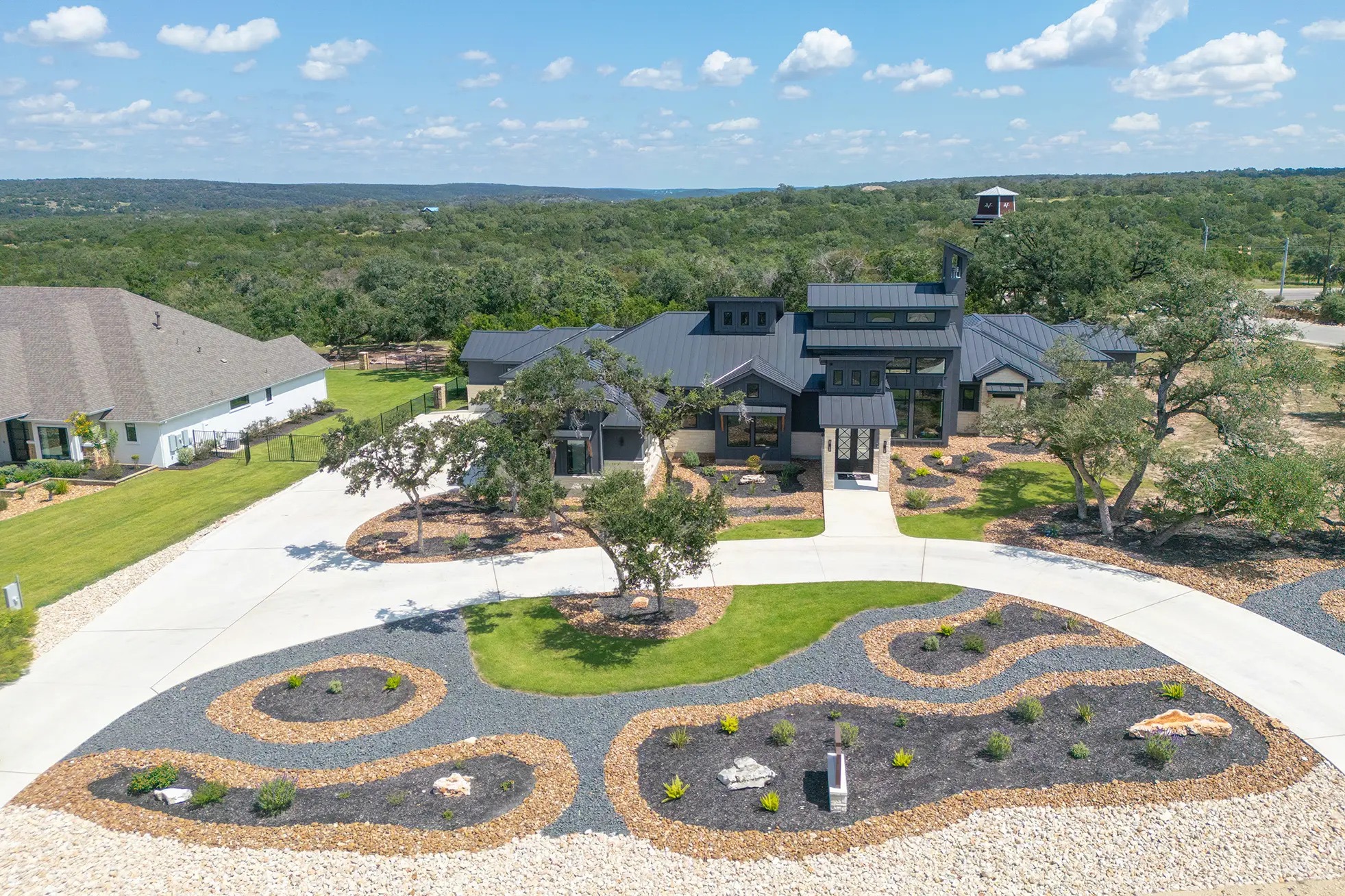
Furthermore, local building codes mandate strict physical separations between underground utilities. For example, your water well head must maintain a strict 100-foot clearance radius from any septic tanks or spray fields to prevent cross-contamination.
Placing your well, your aerobic tanks, your propane storage, and your electrical transformers in a way that respects these setbacks—while still allowing for future additions like a workshop, a detached casita, or a pool—is exactly why comprehensive, up-front architectural site planning is non-negotiable.
Developing raw land doesn’t have to be intimidating. Partnering with a builder who possesses deep, localized expertise in the unique geographic challenges of Central Texas turns potential infrastructure pitfalls into a highly streamlined, predictable engineering process.
Whether you are looking to build on an existing lot in Spring Branch or are actively hunting for acreage near Canyon Lake, we are here to help you evaluate your land's potential from the bedrock up. As one of Central Texas’ most reliable custom home builders, KC Custom Homes proudly serves San Antonio, New Braunfels, Boerne, Spring Branch, Bulverde, Dripping Springs, Canyon Lake, and Marble Falls. To see how we navigate county-specific building codes across Comal, Hays, and Kendall counties, contact our team today to schedule an on-site land consultation.
To request a free quote, please fill the form below. Let us know what features you’re looking for in your next home and our experienced team will contact you shortly.